Hermit crabs defecate and urinate, but they do so in a unique way.
They produce black or brown poop inside their shells. Then, they use their rearmost legs to flick this solid, long, and thin waste away. Hermit crab poop can be other colors, depending upon what they’ve eaten.
Hermit crabs also practice coprophagy, which involves eating their own feces and that of other animals.
Urine is expelled from a duct at the bottom of the antenna, not the anus.
Hermit Crab Poop Information
Hermit crabs must excrete their waste to remain healthy.
They detect food using their antenna. Using their claws (chelipeds), they move food into their mouths. Then, their small mouthparts grind it up, and the mashed food is transferred to the gut.
Within 1-2 days, their digested food is released as fecal waste.
Pooping Inside Shell
Hermit crabs pass feces within their shells. They have an anus, known as the telson, at the base of their anatomy. This is where fecal matter exits the gut.
They remain in their shell while pooping because they feel vulnerable. Hermit crabs realize that leaving their shells to poop endangers their lives.
A hermit crab that isn’t protected by a shell would be plucked from the sand by a passing bird. Even in captivity, a dominant hermit crab may take its shell while it sits unoccupied.
Hermit crabs squirm around to move the fecal matter to the top of the shell. They use their short, rearmost legs to flick waste out of their shells every day or two.
Then, hermit crabs bathe in saltwater to clean and sterilize their shells.
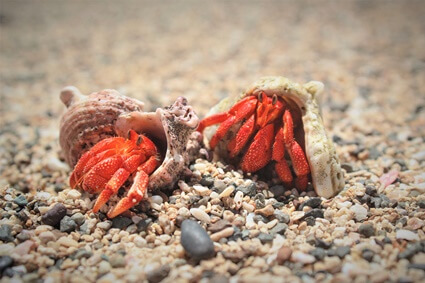
Poop Appearance
Healthy hermit crab poop will be black or dark brown, 10-15 mm long, and sausage-shaped. Their waste will usually be long and curl to the right.
Hermit crab waste often has white dots. In some cases, hermit crab poop is white. This may be due to eating cuttlebone, an essential calcium source.
Some hermit crabs produce smaller, more spherical droppings, while others are larger. Excrement is flicked out of the shell, which may account for varying shapes and sizes.
Some waste may also have been washed away in a saltwater bath.
Poop Smell
Hermit crab waste has no discernable scent. So, foul odors are unlikely to be connected to excrement if you notice a strong smell coming from the tank.
If the tank is odorous, this suggests that cleaning should have been performed. Hermit crab poop may not smell to the human nose, but it attracts mold and bacterial microbes due to the humidity.
A hermit crab tank can become a thriving ecosystem. Hermit crabs eat insects, which, in turn, eat other smaller insects. Unfortunately, not all visitors to the enclosure are desirable.
According to the Journal of Experimental Marine Biology and Ecology, more insects in a tank increase the likelihood of parasites. If parasites are uncontrolled, they become the dominant species.
Pooping Frequency
Hermit crabs eat daily and have small stomachs. Hermit crabs poop daily and sometimes several times per day to maintain a healthy digestive tract.
Cast a cursory eye over the substrate each morning while they sleep. You should find droppings, which suggest the bowels are functioning normally.
You may find that the quantity of waste a hermit crab produces fluctuates, which is diet-related.
Poop Eating
Hermit crabs eat their waste and that of tankmates, which is called coprophagy. “Copros” means feces, and “phagein” means to eat. If you keep marine hermit crabs, they’ll eat fish feces.
When they have saltwater, a hermit crab’s sense of smell is enhanced, which plays a part in consuming fecal matter. While their waste smells neutral to us, it may smell like food to hermit crabs.
No harm is caused by hermit crabs eating feces unless one has recently died. Hermit crabs can die for various reasons, including consuming poisonous substances and toxicity.
Cleaning Up Poop
Hermit crabs are clean animals, so their health and happiness will decline if excessive poop accumulates. Spot cleaning is essential, but you must also thoroughly clean the tank.
Spot cleaning involves putting on rubber gloves, picking out any waste you see, and throwing it away. Never leave this lying around, waiting for your hermit crabs to eat it.
Don’t forget to check the bathing water because hermit crabs use this to clean poop off their shells. This could leave waste floating in the water. Change the water at least once a day.
Every 3-5 weeks, perform a deep clean of the habitat. This involves cleaning the walls and replacing the substrate. Wash any dishes, toys, and decorations in hot water.
Hermit Crab Pee Information
Hermit crabs hydrate several times a day, which is achieved by:
- Scooping water from a dish into the mouth.
- Submerging in a pool to bathe, swallowing water in the process.
- Drinking water that’s stored in the shell to keep the gills moist.
The urine of hermit crabs is recycled in shell water and drank later.

How Hermit Crabs Urinate
Crustaceans don’t pee from the anus. Instead, they urinate through antennal glands (located near the head) via a small opening. Hermit crabs have ‘green glands,’ which function like human kidneys.
You’ll never see hermit crabs pee because they can do so without leaving their shells.
Hermit crabs recycle urine, turning it into drinking water. The urine will be safe to reuse and drink if they haven’t consumed chlorine or heavy metals. All the same, you must change their water regularly.
Hermit crabs may pee on you during handling due to fear-based stimuli.
Peeing Frequency
Hermit crabs urinate regularly, but they do so in such small amounts that it’s hard to see with the naked eye. You could watch a hermit crab for hours and never realize it has gone to the toilet.
Odor of Pee
Hermit crab urine should have a neutral scent. They release ammonia when urinating, but not enough to create a distinctive smell.
If a hermit crab aquarium smells of urine, you’re likely not cleaning it regularly enough. The substrate in the habitat may play a part because sand absorbs urine odors.
Check the water pools of hermit crabs. If they haven’t been changed, they may become pungent.
Cleaning Up Pee
Take a spoon and stir around the substrate to prevent urine from congealing in one area. Consider pouring some filtered water on the substrate because hermit crabs need humidity.
Raking the substrate with a fork is beneficial. Also, wipe down walls and decorations.